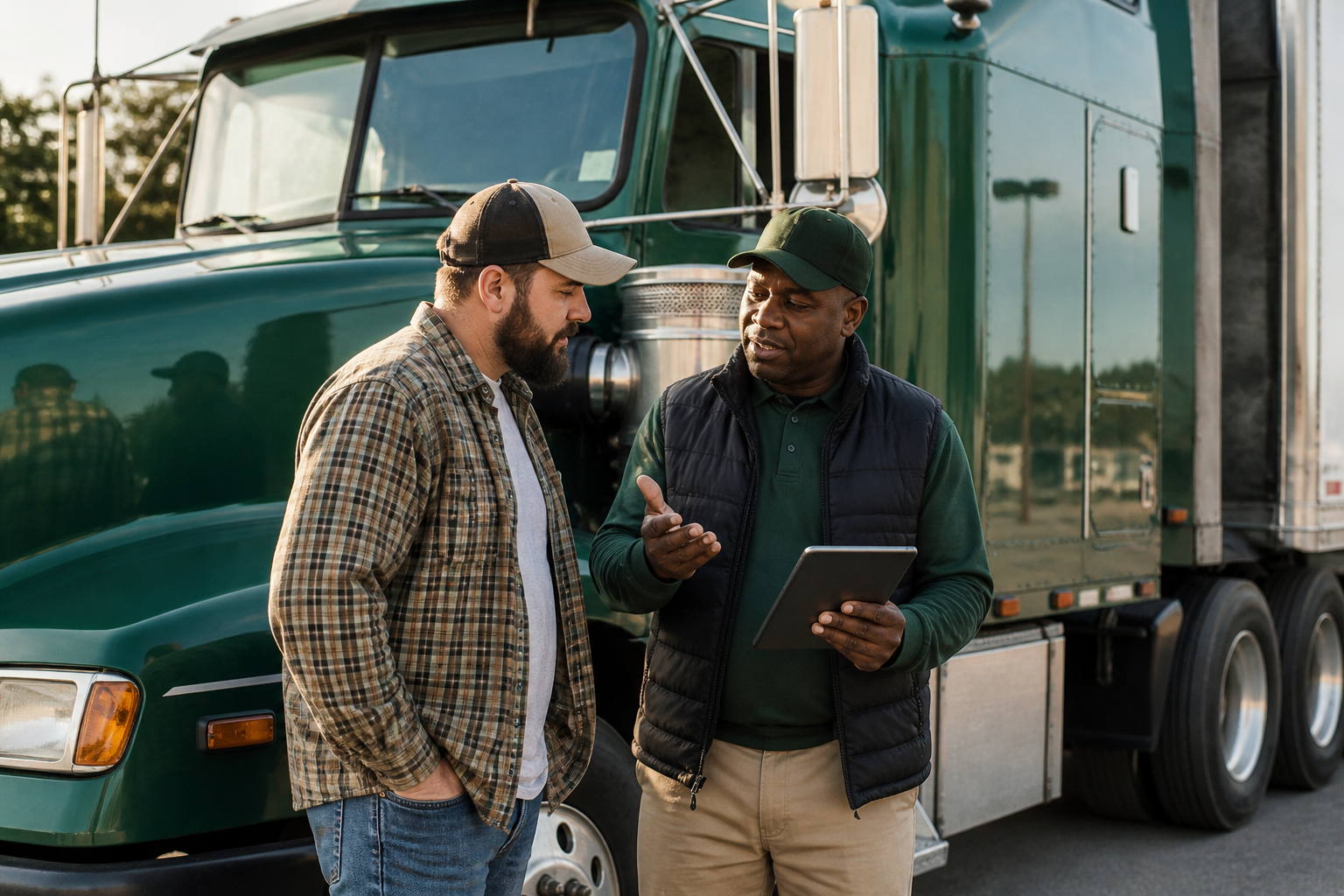
To get a CDL, start with your state licensing agency, choose the class of license that fits your intended work, obtain the required permit, complete applicable training, and pass the state licensing tests. Your state CDL manual is the starting point for documents, appointments, fees, and local procedures.
Key takeaways
- Your state issues your CDL; an online course or practice test does not.
- The permit, required training, and skills test are separate steps.
- Check a training provider in the FMCSA Training Provider Registry and compare its program carefully.
- Build your schedule around the state process, school availability, and test appointments.
Start with your goal and your state manual
Decide what kind of work interests you before paying a school. Ask employers or schools what license class, endorsements, and equipment their roles require. Then use your state licensing agency’s current manual to confirm the requirements for that path.
Class A generally concerns qualifying heavy vehicle combinations; Class B concerns qualifying heavy single vehicles. Class C covers certain passenger or hazardous-material operations that do not fall into the other classes. The classification depends on specific vehicle and use criteria, not simply whether a truck looks large. Compare the detailed FMCSA class definitions with the vehicle you intend to drive.
1. Confirm the application requirements
Ask the licensing agency for its document checklist before booking training. Confirm accepted identification and residency documents, your driving-record requirements, medical certification or self-certification requirements, and applicable fees. Personal eligibility questions should be resolved with the agency rather than assumed from an online article.
2. Get your commercial learner’s permit
A commercial learner’s permit, or CLP, is part of the path toward the skills test. Study the required sections of your state manual and follow the agency’s application and knowledge-testing instructions. A permit allows supervised learning under its applicable restrictions; it is not a full CDL.
Federal rules do not require you to finish ELDT theory before applying for a CLP. A school may arrange its program differently, and states may add requirements. Ask the school to explain exactly when it expects you to obtain your permit.
3. Complete the applicable training
Applicants covered by Entry-Level Driver Training rules need the appropriate training from a registered provider before the relevant licensing test. Check the FMCSA Training Provider Registry, then ask the school about theory instruction, driving practice, scheduling, and what its quoted tuition includes. A registry listing does not replace your own evaluation of the program.
Providers submit training completion electronically to the registry. Ask how you can confirm your record is ready before your test appointment. Keep copies of enrollment paperwork, payment terms, and any school completion documents for your records.
4. Prepare for the skills test
The federal CLP holding period is at least 14 days before the skills test, alongside completion of applicable ELDT. State procedures and appointment availability also matter. The skills test covers vehicle inspection, basic vehicle control, and road driving. Confirm the equipment, paperwork, test location, and retest process directly with your agency or examiner.
Discuss equipment restrictions with your school before choosing a training vehicle. A choice that makes scheduling easier today may affect which vehicles your license permits you to drive later.
5. Finish the state licensing process
After passing, follow the state’s instructions for processing your CDL. Review the class, endorsements, restrictions, and personal details on the issued credential. Passing a school course alone does not complete this step.
A practical planning checklist
- Save your state manual and agency contact information.
- Identify the license class and endorsements relevant to your goals.
- Gather the required application documents.
- Ask schools for written program details and total costs.
- Confirm the permit, training, and test sequence.
- Check that training completion is recorded before testing.
- Allow time for appointments and any retests.
Frequently asked questions
Can I get my CDL entirely online?
Online resources can support study and some theory instruction, but do not replace required driving instruction or the state licensing tests. Confirm the full requirements for your license path before enrolling.
How long will it take?
Ask for a written timeline that includes your permit application, school schedule, driving sessions, required waiting periods, and test availability. A school’s advertised course length may not include the entire licensing process.
Can practice quizzes replace the state test?
No. Our main online CDL Test is a learning resource. Your licensing agency’s exams and requirements determine whether you receive a CDL.
Sources and next steps
Use FMCSA’s CDL application overview and your state agency’s current instructions to check your plan. When ready, compare CDL schools and ask each one how its program fits that process.
Your next step
Compare CDL schools and training options, explore our CDL learning center, or build your knowledge with our main online CDL Test.
AI-assisted educational content. Verify current licensing requirements with your state licensing agency and training provider. Online resources do not replace required training or state licensing exams.